

Let’s do it! TANE Penguins Part 1: How Should We Think About ADC Resolution?

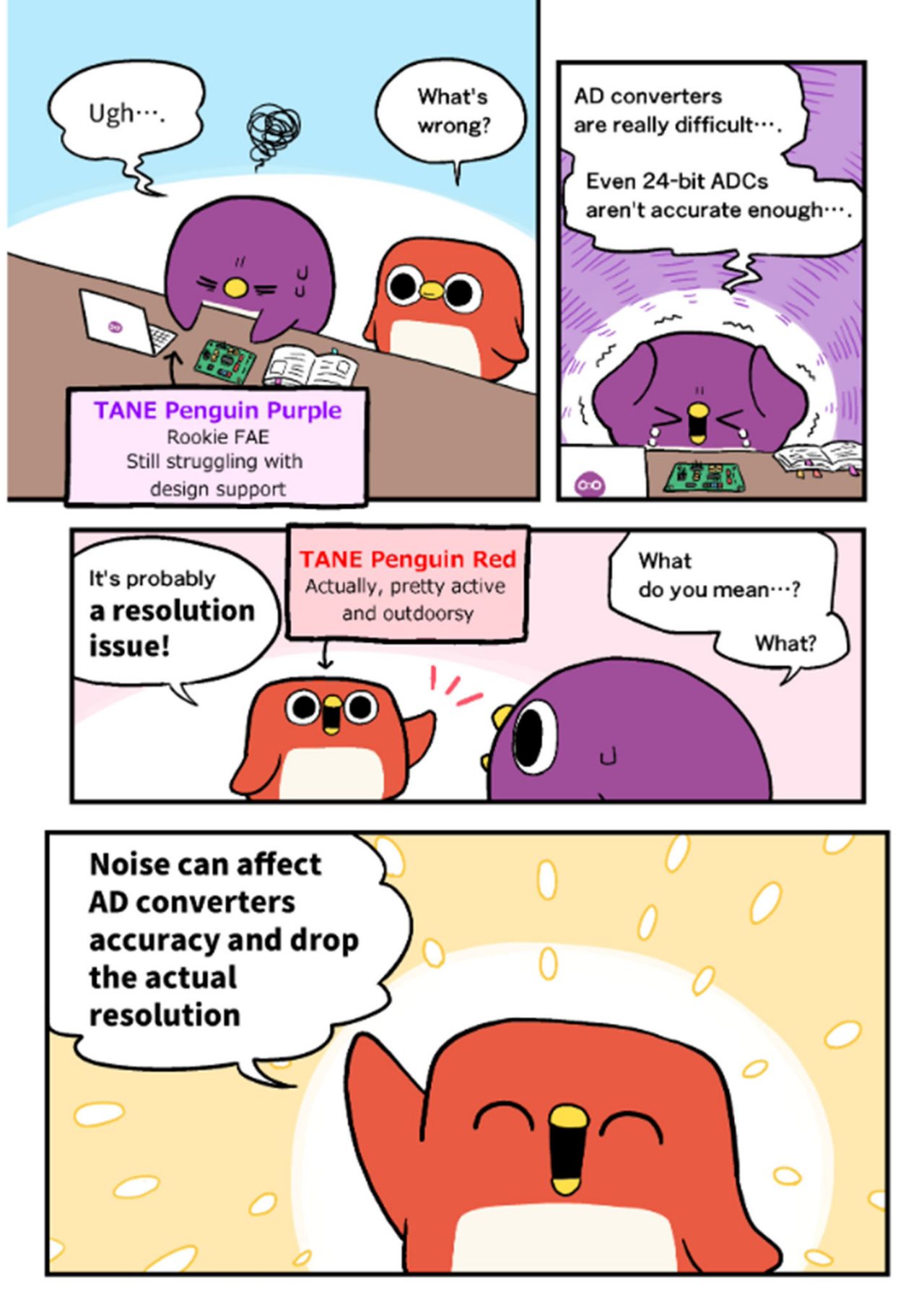

Nice to meet you. I joined MACNICA as a new graduate and am currently working as a young semiconductor FAE.
Since my academic background was in a completely different field, I found it quite challenging to build up my knowledge of analog technology. Among those challenges, one of the areas where I struggled the most was understanding how to evaluate the accuracy of an AD converter when making proposals to customers. In particular, when recommending an AD converter for a customer’s application, I often wondered how I should judge whether the resolution is sufficient.
In this article, I would like to introduce the key concepts related to AD converter resolution that you need to consider when evaluating accuracy.
The Hidden Pitfalls of Resolution
When selecting an AD converter, the first specification that most people pay attention to is its resolution. So naturally, when you open a datasheet, you probably first look at the resolution value shown on the front page. However, there is an important pitfall hidden there.
When I had just finished my training period and started supporting customers, one of my first project meetings included a request: the customer wanted me to recommend an AD converter with at least 24 bits of resolution and good accuracy. So, I introduced a 24 bit device. As soon as the customer opened the datasheet, they began calculating something right in front of me.
After a moment, the customer said, “Not bad, but I wish it were a bit better.”
At that point, I honestly didn’t understand what they meant. I was convinced that the resolution listed on the front page of the datasheet was more than sufficient to meet their requirements. However, that assumption was optimistic. But it turns out that I also needed to consider Effective Resolution and Noise‑Free Resolution.
AD converters naturally generate some amount of noise. This includes converter specific internal noise as well as quantization noise generated during the conversion process. These noise components directly impact the actual usable resolution of the device.
So when evaluating an AD converter’s resolution, you also need to consider not just the nominal resolution on the datasheet but also Effective Resolution and Noise Free Resolution, depending on your application needs.
About RMS Noise and Peak to Peak Noise
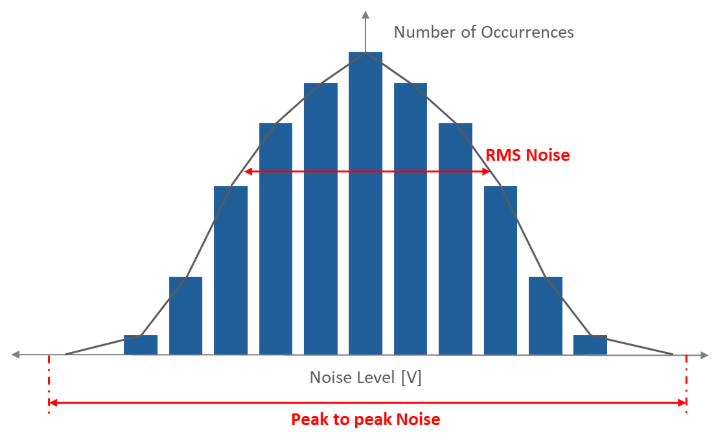
Before getting into the concepts of Effective Resolution and Noise‑Free Resolution, let’s first look at two common ways to describe the random noise contained in the analog input of an AD converter: RMS noise and peak‑to‑peak noise.
Random noise levels are typically represented using one of these two methods. As shown in Figure 2, the amplitude of this noise generally follows a Gaussian distribution.
RMS noise corresponds to the standard deviation calculated from that distribution and represents roughly 99.9% of the noise occurrences. Peak‑to‑peak noise refers to noise spikes that appear with a probability of about 0.1%, and it can be approximated as 6.6 × RMS noise.
Effective Resolution
Effective Resolution can be expressed using the AD converter’s RMS noise and its full‑scale input voltage range:

As an example, let’s calculate the Effective Resolution of the Analog Devices 24‑bit AD converter. The full‑scale input range of an AD converter is determined by its reference voltage, and if it has a built‑in PGA, the gain setting also needs to be considered.
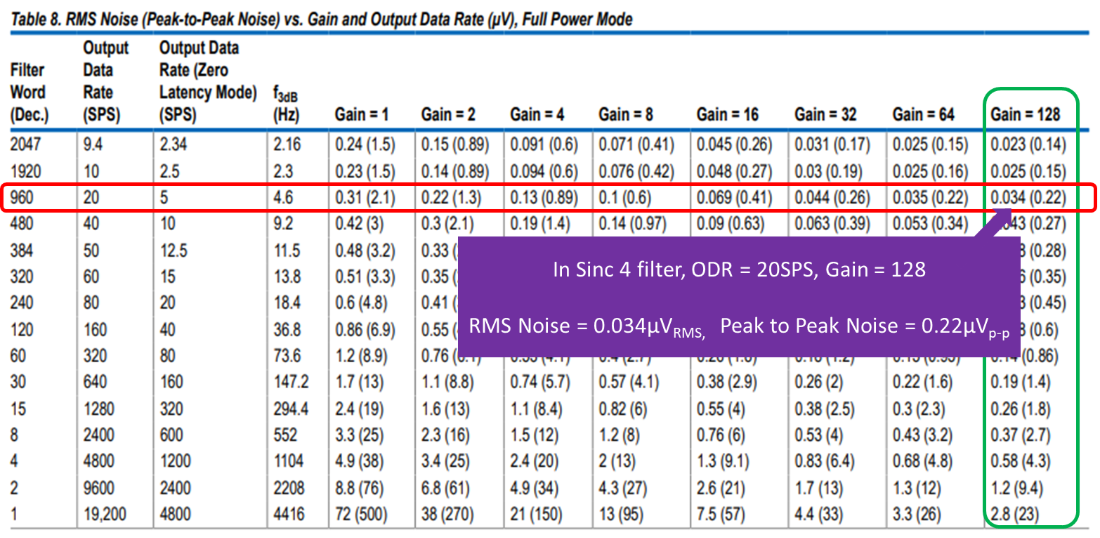
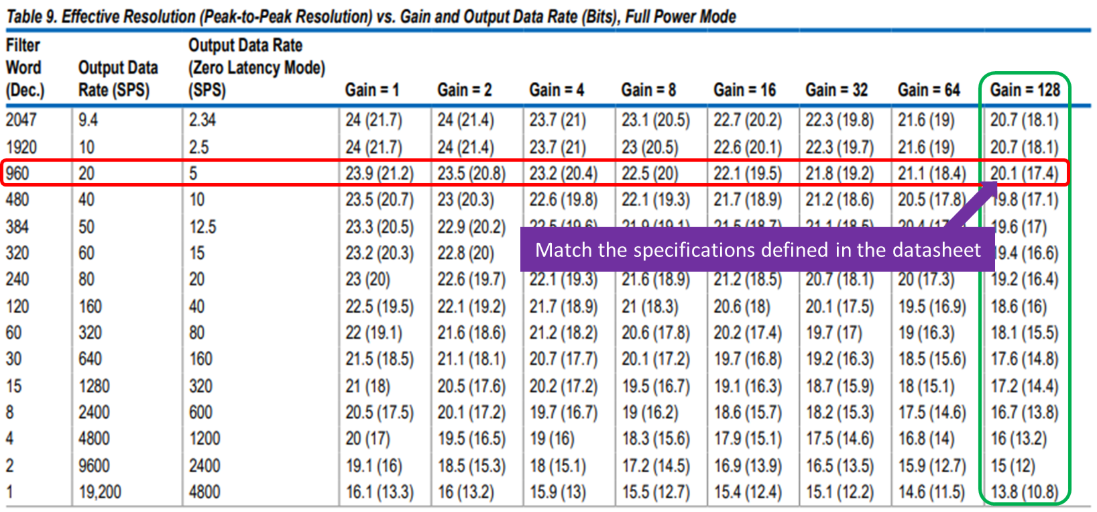
Using the Sinc4 filter, with a sampling rate of 20 SPS, a gain setting of 128, and a 2.5 V reference (Figure 3), the full‑scale input range becomes: ±VREF / PGA = ±2.5 V / 128 = 39.1 mV
According to the datasheet, the RMS noise under these conditions is 0.034 μV.
Therefore, the Effective Resolution can be calculated as follows:

This matches the Noise‑Free Resolution value shown in Figure 4.
Even though the device is specified as a 24‑bit device, once you factor in RMS noise and calculate the Effective Resolution, the actual usable resolution can end up being lower than 24 bits.
This is why it’s important to understand how many bits of resolution your application truly needs when selecting an AD converter.
Next, let’s look at Noise‑Free Resolution.
Noise Free Resolution
Noise‑Free Resolution differs from Effective Resolution in that it uses peak‑to‑peak noise rather than RMS noise. Like Effective Resolution, Noise‑Free Resolution is expressed in bits and is defined as follows:

Let’s walk through an example using the same Analog Devices 24‑bit AD converter, AD7124-4. Using the Sinc4 filter, with a sampling rate of 20 SPS, a gain setting of 128, and a 2.5 V reference (Figure 3), the full‑scale input range is: ±VREF / PGA = ±2.5 V / 128 = 39.1 mV
Under these conditions, the datasheet lists a peak‑to‑peak noise level of 0.22 μVp‑p.

You’ll notice that the Noise‑Free Resolution is about 2.7 bits lower than the Effective Resolution.
This difference comes from the fact that peak‑to‑peak noise is approximately 6.6 times RMS noise, based on the Gaussian distribution.
Peak‑to‑peak noise directly affects how much the digital output code fluctuates.
Therefore, Noise‑Free Resolution offers a more realistic view of the resolution you can reliably use without noticeable code jitter.
This is why both Effective Resolution and Noise‑Free Resolution are important concepts when evaluating the true accuracy of an AD converter.
Conclusion
When evaluating the resolution of an AD converter, it’s important to estimate how many bits of resolution your application will be able to use. Two key metrics help with this: Effective Resolution and Noise‑Free Resolution.
Keep in mind that different AD converter vendors may define or calculate these values differently, so when comparing devices across vendors, make sure you understand how each value is specified.
By considering both Effective Resolution and Noise‑Free Resolution—instead of relying only on the nominal resolution—you can get a clearer view of an AD converter’s true performance and choose a device that truly fits your application.
Related Reading
Let’s do it! TANE Penguins part 2: Key to Improving Resolution
For more information:

Links
Copyright 2026 Macnica Cytech Limited


